
A garden-lighting plan can look simple on paper. Place a few fixtures beside a path, add brighter lights near an entrance, and let the solar panels handle the rest. The problems usually show up later: a tree shades the panel at noon, the battery runs short after several cloudy days, or the light pattern leaves a bright spot followed by a dark gap.
Commercial solar garden lights need more planning than small decorative lights sold for a backyard. A hotel, residential development, park or public entrance has longer operating hours, more users and less tolerance for inconsistent light. The useful starting point is not a product photo. It is a short description of the site and what people need to see there.
Contents
- 1 Start with the task, not the wattage
- 2 Ask for a layout based on maintained light
- 3 Treat solar access as a site constraint
- 4 Compare battery energy, not capacity labels alone
- 5 Read the IP rating in context
- 6 Choose color temperature and distribution together
- 7 Use samples to test the awkward parts of the site
- 8 What to include in a supplier request
- 9 Questions buyers often ask
- 10 A better quote starts with better site information
Start with the task, not the wattage
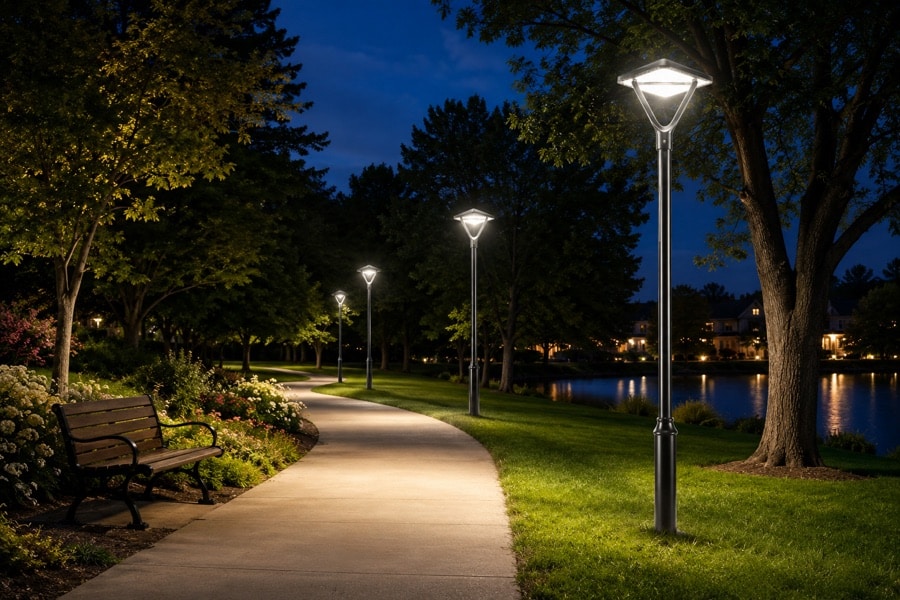
Different parts of a garden need different light. A path needs visual continuity so people can follow its direction and notice changes in level. A gate or lobby approach needs enough light to identify the entrance. Planting beds may only need low-level accent light, and a seating area usually benefits from warmer, softer light than a service route.
Before comparing fixtures, mark these zones on a site plan:
- pedestrian paths, steps and ramps;
- vehicle entrances and drop-off areas;
- gates, doors and signs;
- seating, planting and decorative features;
- trees, walls or buildings that may shade a solar panel;
- places where light spill could affect bedrooms, neighbors or wildlife.
This is also the point to decide whether the project needs a qualified lighting designer. Public paths, parking areas and sites with accessibility or safety requirements should not be designed from a catalogue lumen number alone. The IES Lighting Library includes recommended practices for outdoor pedestrian, roadway and parking applications.
Ask for a layout based on maintained light
Initial output is only part of the design. Dirt on the optical surface, battery aging, seasonal charging conditions and the gradual change in LED output all affect what the site sees over time. A supplier proposal should state the design assumptions and, for larger projects, provide a photometric file or layout that can be reviewed against the site plan.
Spacing matters as much as brightness. Two high-output fixtures placed too far apart can create uncomfortable contrast. A row of lower-output fixtures with better distribution may produce a more usable path. Mounting height, beam pattern, pole position and nearby reflective surfaces all change the result.
For an early quotation, provide the path width, approximate length, desired mounting height and a marked drawing. If the project already has an illumination target, include it. If it does not, ask the supplier what standard or design basis they propose instead of accepting a guess.
Treat solar access as a site constraint
A solar panel rating describes the panel under test conditions. It does not guarantee that the panel will receive enough energy at a particular site.
Check the proposed location at different times of day. Trees that look harmless in summer can create longer shadows in winter. A building south of the fixture may matter little in one region and become the main charging problem in another. Snow, dust, leaves and irrigation spray can also reduce collection if the panel angle and maintenance access are poor.
For northern United States and Canadian projects, request the design solar resource, worst-month assumption and required autonomy. Cold weather also changes battery behavior. NREL notes that lithium battery capacity falls and internal resistance rises at low temperatures. That does not make solar lighting unsuitable for cold regions, but it does mean the battery, control profile and solar array should be selected for the actual winter condition rather than an annual average.
Compare battery energy, not capacity labels alone
Buyers often compare batteries by amp-hours. That can be misleading when the battery voltages differ. Watt-hours provide a better basis for comparing stored energy:
battery watt-hours = nominal voltage x amp-hours
The number still does not tell the whole story. Ask about usable depth of discharge, low-temperature limits, charge-control protection, expected cycle conditions and replacement access. A well-sized battery paired with an aggressive full-output schedule can still run short. A sensible dimming profile may deliver steadier service with a smaller system.
The operating schedule belongs in the RFQ. State whether the light should run at full output all night, dim after a set time, or increase output when a motion sensor detects activity. Ask the supplier to state the assumed hours per night and the number of low-sun days covered by the design.
Read the IP rating in context
An IP rating is useful, but it is not a complete durability claim. A garden fixture close to sprinklers, soil and foot traffic faces a different exposure from a luminaire mounted several meters above a path.
Ask which components carry the rating and request the test report when the rating is important to the project. Then review the housing material, fasteners, seals, cable entries, drainage and UV exposure. UL Solutions notes that outdoor luminaires may also need evaluation for wet locations, ultraviolet exposure and low temperatures. North American buyers should not assume that an IP number is a substitute for every local safety or installation requirement.
The UL Solutions overview of landscape and outdoor lighting is a useful reference when preparing compliance questions for United States and Canadian projects.
Choose color temperature and distribution together
Color temperature affects how a garden feels, but it also affects glare and environmental impact. Warm light often suits hospitality gardens, residential paths and landscape features. Cooler light may appear brighter, yet that does not automatically make a path easier to use.
DarkSky and IES recommend that outdoor light be useful, targeted, low-level, controlled and warm-colored where possible. Their five principles for responsible outdoor lighting are a practical check against over-lighting a site.
Shielding and optical control usually matter more than adding output. A visible LED source near eye level can feel harsh even when the measured light on the path is modest. Ask for nighttime product photos, beam information and, when available, glare or photometric data.
Use samples to test the awkward parts of the site
A sample is most useful when it answers a specific question. Do not test it only on a clear summer day beside the purchasing office.
Install the sample at the intended height and panel orientation. Observe the path after dark, including the transition between fixtures. Check charging where partial shade is expected. Run the planned dimming or sensor mode. Inspect the mounting hardware, battery access, gasket seating and the way water drains from the housing.
If the project needs private-label packaging or a custom finish, approve those details on the sample record as well. Photographs, signed specifications and a clear sample revision number reduce arguments when mass production begins.
What to include in a supplier request
A useful RFQ for solar lights for garden projects should include:
- site location and application type;
- marked plan with path widths and fixture positions;
- mounting height and installation surface;
- required operating schedule and dimming behavior;
- winter or rainy-season performance expectations;
- preferred color temperature and finish;
- target quantity, sample requirement and delivery destination;
- required reports, labels, manuals and packaging;
- logo, color, carton and barcode requirements for OEM orders.
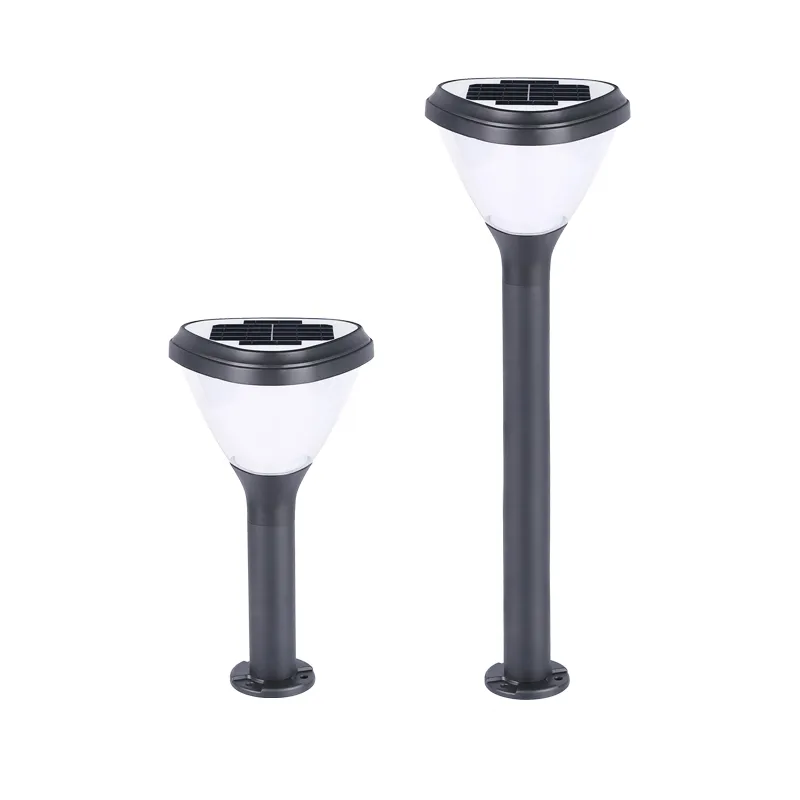
Doralight supplies solar garden lights for paths, entrances and landscape projects. Buyers comparing taller fixtures can also review the garden solar pole lamp ZC-TYD2609 and the broader solar outdoor lighting catalog.
Questions buyers often ask
How many lumens should a solar garden light have?
There is no reliable single number for every garden. Path width, mounting height, optical distribution, surface reflectance, spacing and nearby ambient light all change the result. Define the task and request a layout for commercial or public projects.
Is IP65 enough for a garden project?
IP65 may suit many exposed fixtures, but the application still matters. Irrigation, standing water, salt exposure, UV, temperature and mounting location can require additional checks. Request the relevant test report and review local wet-location requirements.
Can solar garden lights work through winter?
They can, provided the solar array, battery and operating profile are designed for the site's winter solar resource and temperature. Ask for the worst-month design basis and low-temperature battery limits.
What should an OEM buyer approve before production?
Approve the exact model, electrical configuration, finish, logo position, labels, manual, barcode, packaging, sample revision and inspection criteria. Keep these items in one signed specification pack.
A better quote starts with better site information
The fastest quote is not always the useful one. A supplier can price a model from a quantity, but they cannot judge runtime, spacing or winter performance without site conditions and an operating schedule.
Send the uncomfortable details early: shade, long winter nights, sprinkler exposure, custom packaging and the date the goods must arrive. Those details help the supplier propose a configuration that can be tested before the order grows.
Send Doralight your garden-lighting plan and RFQ for model selection, sample availability and OEM review.