Contents
- 1 TL;DR
- 2 Abstract
- 3 Key Takeaways
- 4 Table of Contents
- 5 Master manufacturer qualification checklist
- 6 Why a manufacturer checklist matters before you request samples
- 7 Verify supplier identity, factory control, and export readiness
- 8 Check product specifications as a complete lighting system
- 9 Confirm compliance, battery transport, and US or Canada paperwork
- 10 Review OEM scope, packaging controls, and after-sales obligations
- 11 Common mistakes buyers make when screening solar garden light suppliers
- 12 Conclusion
- 13 FAQ
- 13.1 Who makes the best solar garden lights?
- 13.2 What is the 20% rule for solar?
- 13.3 What is the solar system service checklist?
- 13.4 What to look for when buying outdoor solar lights?
- 13.5 Can a supplier provide UN38.3, MSDS, and Transport Canada battery shipping documents for trial and bulk orders?
- 13.6 What should buyers confirm in an OEM or private-label solar lighting warranty?
- 14 References
TL;DR
Use this checklist to qualify solar garden light manufacturers before you approve samples, compare OEM options, or sign a bulk order. The safest screening flow is supplier identity first, system-level specs second, compliance and battery paperwork third, and commercial after-sales terms last.
Abstract
A reliable solar garden light supplier checklist should verify who controls production, how the lighting system is specified, which North America documents are real, and how defects are handled before any bulk order moves forward.
Guide ownership and review: Content owner: Doralight Solar Lighting team. Editorial basis: 10 primary standards-body and government sources listed below. Last reviewed: August 2026. This is a procurement screening framework, not a product certification or engineering approval. It does not rely on unverified Doralight performance data, customer results, factory-capacity claims, or compliance claims.
Key Takeaways
- Verify whether the supplier controls the factory, not just the website.
- Review the full lighting system, not isolated panel or LED claims.
- Separate IP ratings from North America safety listing requirements.
- Ask for battery transport documents before approving trial or bulk orders.
- Put OEM ownership, warranty scope, and defect handling in writing.
Table of Contents
- Abstract
- Key Takeaways
- Master manufacturer qualification checklist
- Why a manufacturer checklist matters before you request samples
- Verify supplier identity, factory control, and export readiness
- Check product specifications as a complete lighting system
- Confirm compliance, battery transport, and US or Canada paperwork
- Review OEM scope, packaging controls, and after-sales obligations
- Common mistakes buyers make when screening solar garden light suppliers
- Conclusion
- FAQ
- References
Master manufacturer qualification checklist
A manufacturer decision should be auditable from one register, not reconstructed from emails, samples, and certificate folders. For every decision area, record the exact evidence reviewed, confirm that each document matches the quoted model or controlled version, name the owner, and apply the same accept, pause, or reject rule.
| Decision area | Exact evidence to record | Model or version match | Responsible owner | Decision rule |
|---|---|---|---|---|
| Supplier identity/factory control | Legal entity, payee, site and audit records, quality-control owner, exporter, and corrective-action owner | Names and site IDs match quotation and audit | Procurement and supplier quality | Accept: chain and owners are traceable. Pause: correctable evidence is missing or outdated. Reject: identities conflict, production is hidden, or site evidence is refused. |
| Complete-system specifications | Controlled bill of materials, sample ID, luminaire report, component IDs, controller settings, energy assumptions, and site conditions | SKU, sample, report, bill of materials, battery, controller, and firmware agree | Product engineering and quality | Accept: evidence covers offered system and use. Pause: configuration or assumptions remain open. Reject: substitutions or reports do not match. |
| Compliance/battery transport | Requirement, scope, issuer, document ID, cell and pack IDs, test summary, classification, packing, and label instructions | Records match product, battery, destination, and route | Compliance, importer, and logistics | Accept: records are verified and applicable. Pause: route or applicability is unconfirmed. Reject: evidence is altered, unverifiable, mismatched, or absent. |
| OEM/change control | Tooling ownership, design rights, approved artwork, packaging files, sample approval, change requests, and history | Files carry an ID, revision, date, and linked configuration | Buyer product and supplier engineering owners | Accept: baseline and authority are signed. Pause: revisions or ownership remain open. Reject: substitutions are unauthorized, files uncontrolled, or ownership conflicts unresolved. |
| After-sales/warranty | Warranty owner, coverage, exclusions, proof, start event, remedy, costs, spares, escalation, checkpoints, and corrective action | Terms match SKU, market, program, and signed version | Buyer service and quality, plus supplier commercial and technical owners | Accept: duties and remedies are written. Pause: terms are vague or owners missing. Reject: documents conflict or no party owns warranty and defects. |
Do not average these rows into one supplier score. A reject in identity, safety, transport, or change control should stop approval until the candidate is removed or the contradiction is resolved with verified evidence. Record who changed a pause to accept, why, and which record it replaced.
Why a manufacturer checklist matters before you request samples
A solar garden light manufacturer checklist should qualify the supplier before samples absorb budget and attention. UL guidance for ANSI/CAN/UL 8801 evaluates the battery system, controls, and luminaires as integrated components, showing why one attractive sample or an isolated component claim cannot establish complete-system readiness. (UL Solutions, n.d.-a)
Why supplier websites can look stronger than factory control
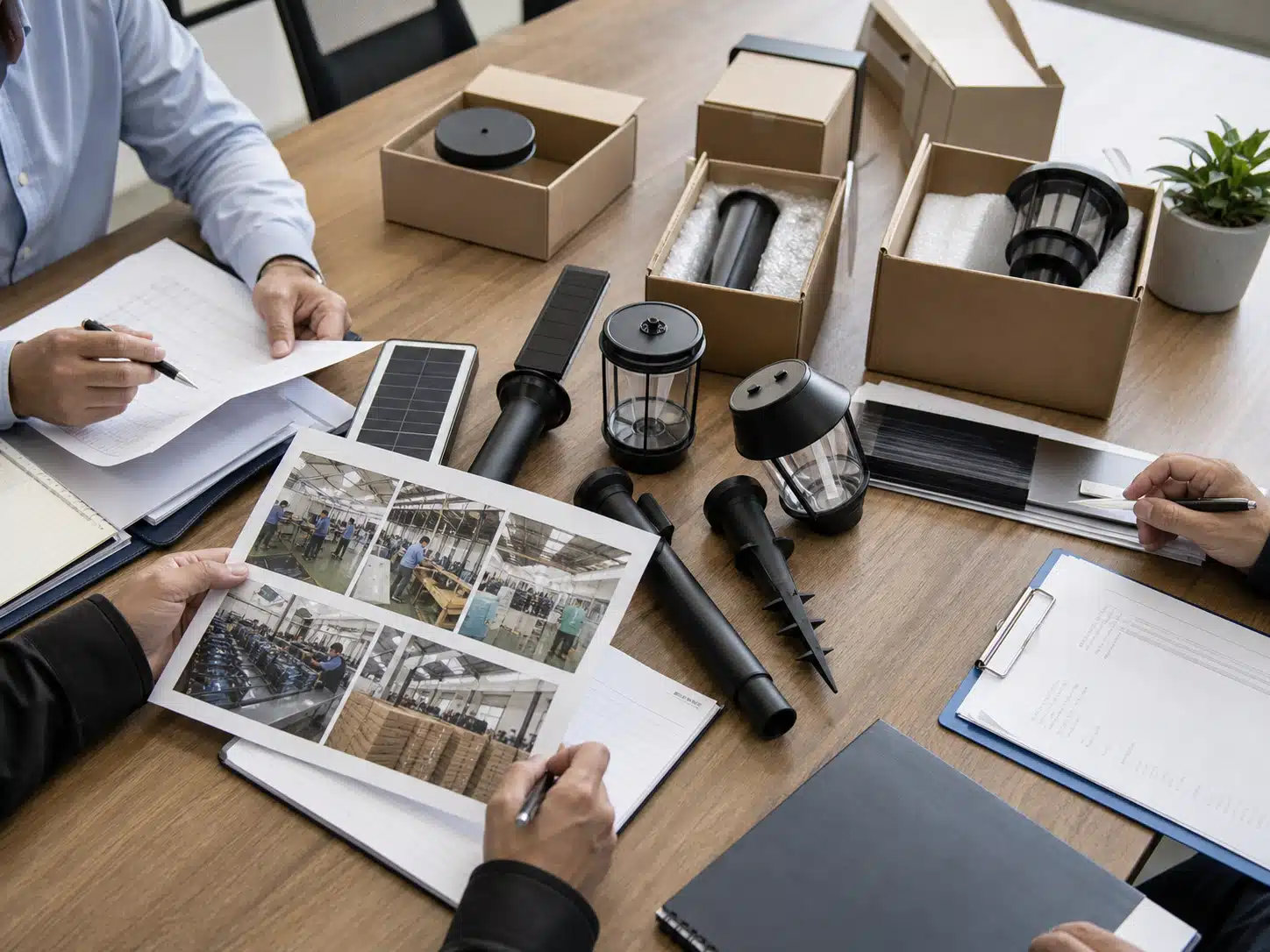
A direct manufacturer, trading intermediary, and private-label coordinator can present similar product photos, customization language, catalogue breadth, and quality assurances. Those visible signals do not identify who controls engineering changes, incoming materials, inspection records, or corrective action when defects appear. A solar garden light manufacturer checklist converts each claim into a pass-fail request for evidence. The aim is not to reject intermediaries automatically. It is to make the supplier’s role, control points, and accountability explicit before the buyer pays for samples.
Which buyer risks appear before a purchase order is signed
Sample cost is only the first exposure. Buyers may also commit engineering time, freight, test fees, packaging work, and launch schedules before signing a purchase order. An attractive sample does not resolve whether production will follow the same bill of materials, documentation set, or approval path.
Important: Do not treat a sample as a substitute for supplier qualification. Approve sampling only when unanswered items are documented, assigned to an owner, and tied to a decision date.
Use the solar garden light manufacturer checklist to stop the process when supplier identity, product evidence, compliance records, or defect ownership remains unclear. The next screen establishes who the supplier is, what production control it holds, and whether its export records support the proposed transaction.
Verify supplier identity, factory control, and export readiness
A solar garden light manufacturer checklist should trace the legal entity, producing site, quality-control owner, and exporter of record. Require documents that connect the quoted company to the factory before samples or customization.
Supplier approval should start with a fixed 4-step identity screen. The State Administration for Market Regulation supports legal-entity checks for China-based suppliers; buyers should then verify factory control, export readiness, and ownership of failures before paying for samples or customization, because an unresolved owner leaves accountability unassigned.
How to separate a direct manufacturer from a trading intermediary
Ask each candidate to declare its business model before discussing price. The label matters less than whether the supplier can show who controls production, inspections, design changes, and defect escalation. Use the same disclosure standard for every candidate so a polished website does not receive extra weight.
| Supplier model | Minimum disclosure to request | Pass signal |
|---|---|---|
| Direct manufacturer | Legal entity, producing site, production responsibility, QC ownership, and exporter relationship | Factory access and records connect the quoted entity to production |
| OEM/ODM coordinator | Producing factory, design-control owner, QC oversight, and warranty owner | Responsibilities are written and the factory is visible to the buyer |
| Trading company | Intermediary status, source factory, inspection method, and defect escalation path | The supply chain is traceable and factory evidence is available |
Do not reject an intermediary solely because it does not own production. Reject ambiguity. A coordinator may be suitable when it identifies the factory and records its responsibilities. If a contact cannot explain who makes, checks, ships, and corrects the product, the buyer cannot assign accountability.
Which audit, registration, and export records reduce approval risk
Run the solar garden light manufacturer checklist in a fixed 4-step sequence:
- Confirm the legal entity. Check registration and current business status, then compare the entity name with the quotation, contract, and payment beneficiary. For China-based suppliers, the National Enterprise Credit System can support the registration check. (State Administration for Market Regulation, n.d.)
- Confirm factory control. Request a current factory audit or arrange an independent one. The review should compare claimed capacity with equipment, production flow, QC processes, and staffing at the disclosed site.
- Confirm export readiness. Ask for evidence of export history, the exporter-of-record relationship, and sample export documentation. A marketplace badge is not a substitute for those records.
- Assign ownership of failures. Record who approves changes, holds inspection evidence, and responds when defects occur. Treat an unresolved owner as a failed check.
The useful result of a factory audit is whether site evidence matches the supplier’s claimed operation, not the audit badge alone.
Once identity, factory control, and export responsibility pass, the next review can test whether the proposed solar garden lights are specified as one complete system.
Check product specifications as a complete lighting system
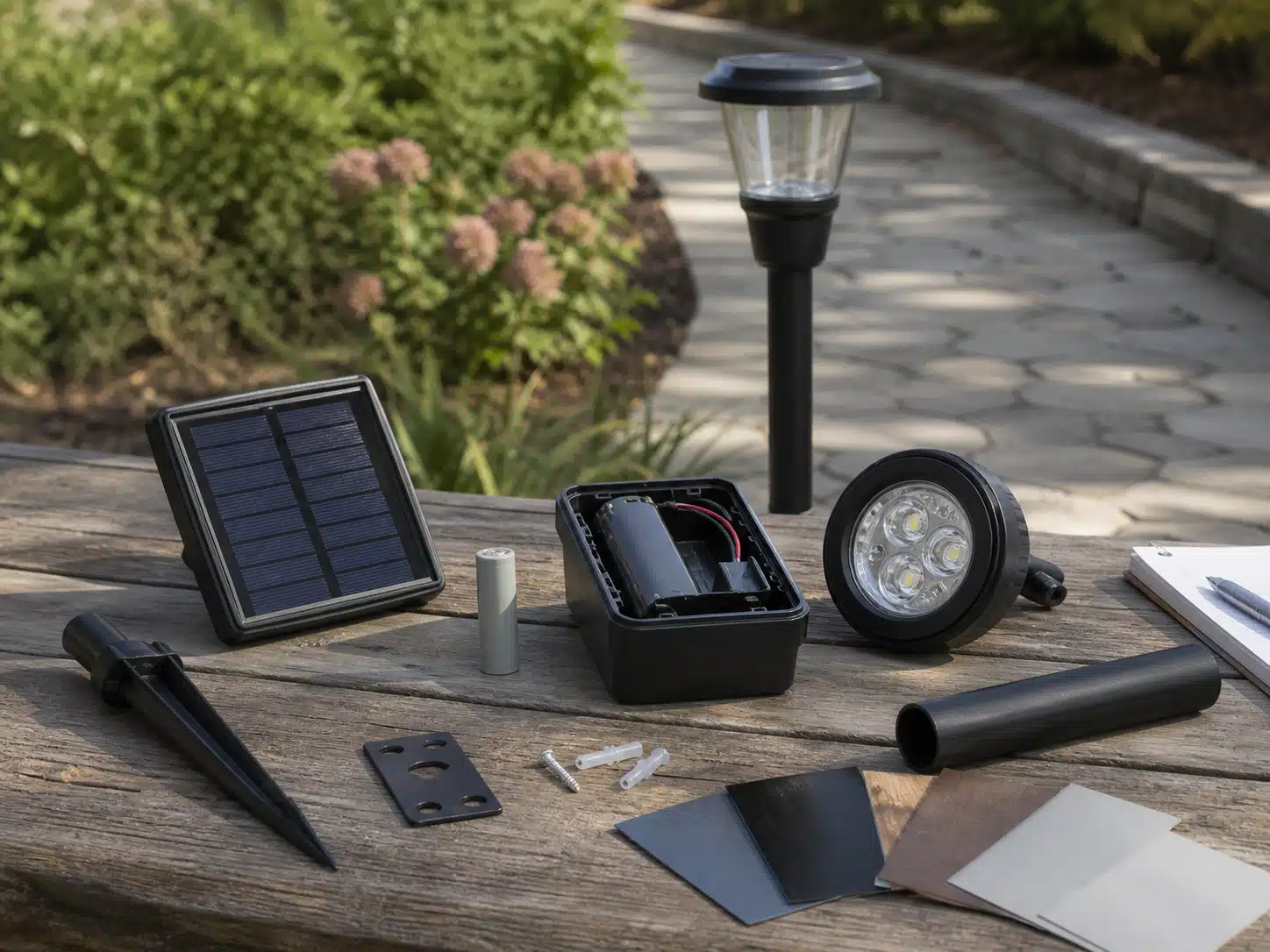
Treat every solar garden light as one energy and lighting system. A panel, battery, controller, LED board, optic, housing, firmware profile, and installation site must work together. A useful solar garden light manufacturer checklist therefore compares the tested luminaire and energy budget with the actual nights, climate, and duty cycle the project requires.
Complete-luminaire evidence should govern solar garden light approval. The Illuminating Engineering Society’s 2024 LM-79 method covers total luminous flux, intensity distribution, efficacy, CCT, CRI, input power, voltage, and current for the assembled product, while UL Solutions treats the battery, controls, and luminaire as one integrated ANSI/CAN/UL 8801 system.
Which technical questions matter more than a catalog headline
A headline lumen figure cannot show distribution, electrical demand, or overnight control. Request evidence for the exact sampled configuration, then check every value describes the finished luminaire, not an LED chip or isolated component.
- Verify complete-luminaire output. Ask for a photometric report covering total luminous flux, intensity distribution, efficacy, CCT, CRI, input power, voltage, and current for the assembled product. LM-79 testing covers those complete-luminaire measurements. (Illuminating Engineering Society, 2024)
- Connect the operating profile to the energy budget. Record full-output hours, dimming periods, motion settings, and controller losses.
- Trace the tested configuration. Match the report, sample label, bill of materials, battery pack, controller settings, and firmware revision.
- Set acceptance criteria before sampling. State which values the supplier must declare, which the buyer will verify, and what variance causes rejection.
Why luminaire testing, battery chemistry, and climate assumptions must match the project
Battery chemistry is only one input. Buyers also need rated capacity, cycle-life test conditions, charge and discharge limits, temperature range, autonomy target, and calculation assumptions. Site data should cover the lowest-solar period, shading, panel orientation, required nightly hours, and lighting profile.
- Ask for the housing, lens, fastener, gasket, coating, and exposed-plastic materials, with the intended corrosion and ultraviolet exposure.
- Recalculate autonomy against the specified lighting schedule and project conditions, not a generic sunny-day result.
- Confirm which temperature limits apply to charging, discharging, storage, and the complete luminaire.
- Record the exact ingress target. IEC 60529 defines the IP code used for enclosure-protection ratings. (International Electrotechnical Commission, 2013)
ANSI/CAN/UL 8801 treats a photovoltaic luminaire as an integrated system: the battery, controls, luminaire, and any supplemental utility supply are evaluated together. Component data alone cannot describe the finished system. (UL Solutions, n.d.-a)
With the technical baseline fixed, compliance review can match paperwork to the exact system rather than a generic family.
Talk to the factory
Compare models in the Doralight solar garden light range, then share your installation location, quantity, application, target specifications and OEM/ODM needs through the Doralight quote form.
Confirm compliance, battery transport, and US or Canada paperwork
North American paperwork should match the product architecture and destination, not a generic certificate bundle. ANSI/CAN/UL 8801 evaluates photovoltaic luminaire systems with the battery, controls, luminaire and any supplemental utility source as integrated components. A component certificate alone does not establish system-level coverage. (UL Solutions, n.d.-a)
Which safety and system standards buyers should distinguish
Classify the SKU as a photovoltaic luminaire system, line-voltage luminaire or low-voltage lighting system before requesting documents. The applicable evidence follows the architecture and intended installation.
| Evidence area | Scope to distinguish | Buyer file |
|---|---|---|
| Integrated photovoltaic luminaire system | ANSI/CAN/UL 8801 addresses the battery, controls, luminaire and any supplemental utility source as an integrated system. Confirm that the listing scope covers the offered architecture and exact model. (UL Solutions, n.d.-a) | Listing or certificate, report scope, exact model, variants and intended installation |
| Line-voltage luminaire | UL 1598 with CSA C22.2 No. 250.0 addresses line-voltage luminaires. Confirm the standard, installation conditions and model coverage with the testing body. (UL Solutions, n.d.-b) | Listing or certificate, report scope, exact model, variants and intended installation |
| Low-voltage lighting system | UL 1838 or UL 2108 may apply, depending on the low-voltage architecture and intended installation. Confirm applicability instead of treating either standard as universal. (UL Solutions, n.d.-b) | Listing or certificate, report scope, exact model, variants and intended installation |
| Enclosure ingress protection | IEC 60529 defines the IP Code for enclosure protection. Treat this as separate from product safety listing requirements. (International Electrotechnical Commission, 2013) | Exact-model IP test report, rating, test conditions and enclosure configuration |
| US FCC or EMC | Check FCC Part 15 applicability for electronic devices sold in the United States. (Electronic Code of Federal Regulations, n.d.) | Applicable report or declaration and label artwork tied to the exact electronics |
| Lithium transport and Canada import | Confirm UN Manual testing plus TDG classification, documentation, labelling, packaging, training and proof of classification. (Transport Canada, 2026; Transport Canada, n.d.) | Battery test evidence, classification proof and mode-specific declaration, packing and label instructions |
A CE mark may belong in a Europe-focused file, but it is used for products placed on the market in the European Economic Area. Treat any certificate without a matching model, stated scope, issuer and verifiable number as unresolved. (European Commission, 2021)
What to request for lithium battery shipping and import documentation
Request the battery pack model, cell model, chemistry, watt-hour rating and the relationship between the tested battery and the production SKU. The UN Manual lists 8 tests, depending on battery type and design. As a procurement evidence check, require a battery-specific test summary that identifies the manufacturer, battery model, laboratory, report number and date, and the applicable T.1 through T.8 outcomes. The transport file should also identify whether the battery is contained in equipment or packed with it, and support the classification, declaration, packaging and labels for the intended mode. For Canada, retain proof of classification and TDG-related records. Requirements vary by transport mode. (Transport Canada, 2026; Transport Canada, n.d.)
Use the solar garden light manufacturer checklist as an evidence register. Record the covered SKU, battery identifier, document holder, issuing body, edition or date, and verification status. Have the carrier, import broker or testing body confirm applicability to the actual route. After approval, lock compliance-sensitive bill-of-material identifiers and label artwork before reviewing OEM control, packaging approval and after-sales ownership.
Review OEM scope, packaging controls, and after-sales obligations
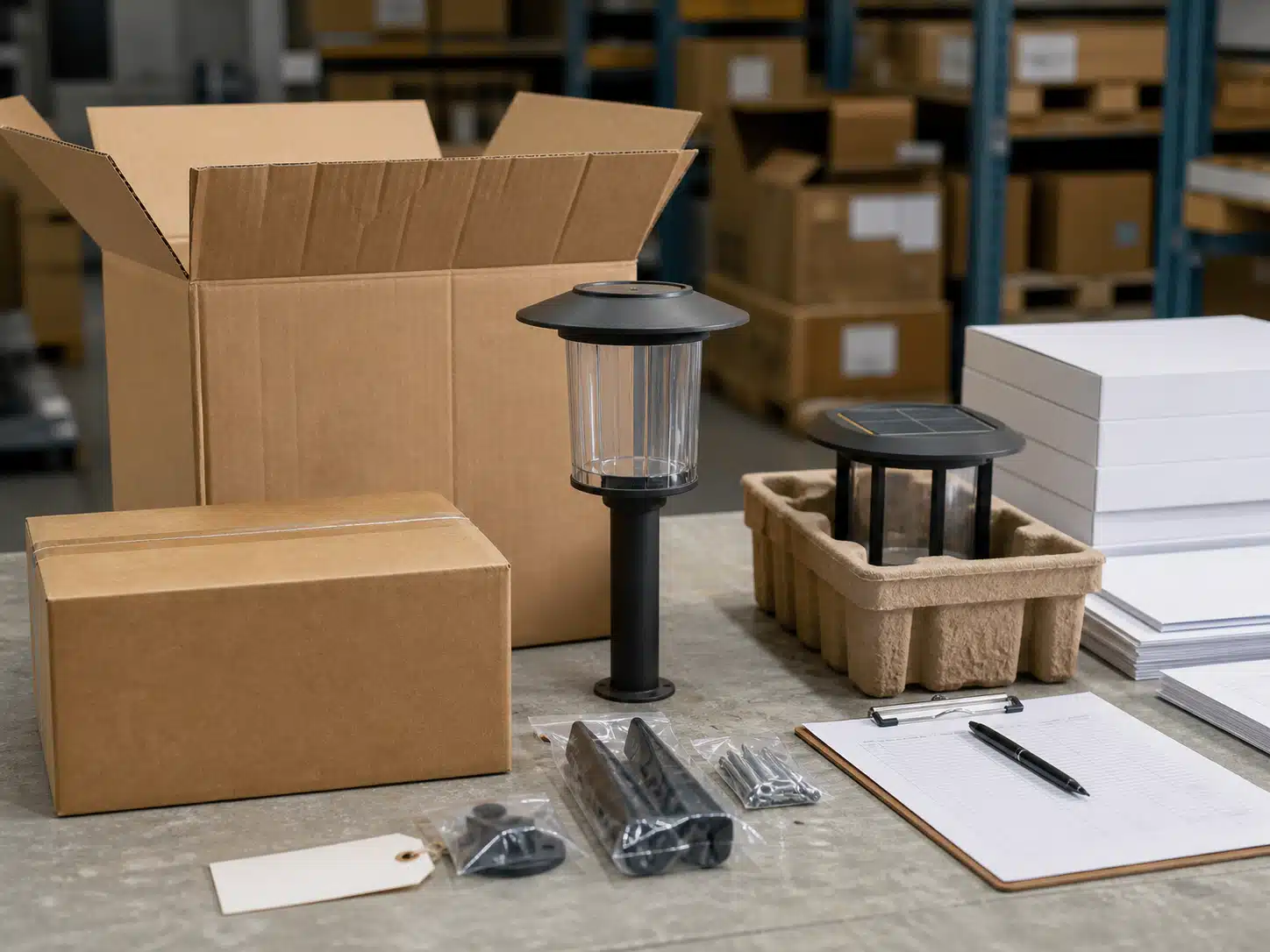
The commercial section of a solar garden light manufacturer checklist should turn each customization promise into an approved record. Treat the sample, artwork, carton, and warranty process as separate approvals with named owners. A sample alone does not allocate later costs or decision rights.
Which OEM or private-label terms should be signed before production
Before production, use the solar garden light manufacturer checklist to settle these points:
- Tooling and molds. Record who pays, owns, stores, and maintains each asset, plus its disposition when the relationship ends.
- Confidentiality and design control. Define NDA scope, file access, production separation, and rights to customer-funded molds in writing.
- Change approval. Name who can approve substitutions, artwork, firmware, or packaging revisions. Link each approval to a dated version.
- Packaging control. Sign off the unit box, master carton, inserts, barcode data, country markings, pallet pattern, and export-document fields before mass production.
Warning: Sample approval should not authorize changes to artwork, labels, components, carton construction, or packing method. Require a new controlled proof or signed sample when an approved detail changes.
UL 969 provides a named performance basis for marking and labeling systems, so packaging approval should identify which product labels must remain attached and legible under intended conditions. Where several marking regimes apply, each label must satisfy every applicable requirement rather than relying on one generic durability statement. (UL Solutions, n.d.-c)
How to define warranty ownership, spare parts, and escalation paths
Close the solar garden light manufacturer checklist with an operating agreement for field problems:
- Warranty owner. State whether the manufacturer, importer, or private-label seller receives claims and handles customer communication.
- Coverage boundary. Define covered parts, exclusions, evidence required, remedy method, and the event that starts the warranty period.
- Remedy costs. Allocate replacement products, spare parts, diagnostic work, freight, duties, and field labor.
- Escalation path. Name contacts for technical review, commercial approval, corrective action, and unresolved cases, with agreed response checkpoints.
Private-label contracts should allocate warranty responsibility explicitly. Separate technical support, warranty handling, and product-inquiry management into named after-sales duties. Unassigned duties become vague promises to challenge during final supplier screening.
Common mistakes buyers make when screening solar garden light suppliers
A solar garden light manufacturer checklist fails when convenience is mistaken for evidence. Low price, fast quote, or a polished PDF can open a comparison, but none should close approval.
Why low price, IP claims, or a fast quote can still hide major risk
- Reconcile the cheapest quote with the approved bill of materials, complete-luminaire data, sample result, and written warranty scope. A low price is not evidence that the delivered configuration will match the approved sample.
- Treat a same-day quote as a response-speed signal only. Ask who confirmed the battery, panel, controls, housing, packaging, and production route before accepting the number.
- Reject any IP claim that is not tied to the exact model and test document.
How to catch certificate misuse, weak batteries, and vague after-sales language
UL Solutions ties ingress protection to EN 60529, which indicates a product’s ability to withstand penetration from moisture and dust, while line-voltage luminaires are evaluated under UL 1598. An IP claim therefore does not replace the safety evidence required for the product and installation being purchased. (UL Solutions, n.d.-b)
- Match each certificate number, holder, model, variant, and issuing body to the offered unit; a similar family name is not a match.
- Compare the battery model in the bill of materials with the transport record. Transport Canada asks importers for documented proof that batteries meet the UN Manual and for proof of classification. (Transport Canada, 2026)
- Replace "warranty available" with named responsibility for diagnosis, replacement parts, freight, labor, approval limits, and escalation. The solar garden light manufacturer checklist passes only when these terms are written for the transaction.
Conclusion
A solar garden light manufacturer checklist should end with a sourcing decision, not a pile of brochures. Pass supplier identity and factory-control checks. Match complete-system specifications to the intended site. Verify market-specific compliance and battery transport records. Assign ownership for samples, tooling, packaging, change control, warranty claims, replacement parts, and defect escalation.
ANSI/CAN/UL 8801 evaluates photovoltaic luminaire systems at system level, including the battery, controls, luminaires, and any supplemental utility source. (UL Solutions, n.d.-a) Transport Canada requires lithium battery shipments and imports to meet classification, documentation, labelling, packaging, training, and UN Manual testing requirements for safe transport. (Transport Canada, 2026)
Pass rule: Advance a supplier only when every required document names the product, scope, issuer, responsible owner, and acceptance criterion. Pause the shortlist when any gap affects safety, shipping, field performance, or commercial responsibility.
Before sending an RFQ, compile installation location, application, target quantity, performance requirements, climate assumptions, destination market, sample plan, branding scope, and required documents. Use the same evidence pack for every shortlisted supplier. It turns the first factory conversation into a recordable gap review rather than another sales presentation.
FAQ
Who makes the best solar garden lights?
There is no universal "best" manufacturer for every B2B program. The strongest fit is the supplier that proves legal identity, factory control, exact-model system performance, destination-market documents, battery transport records, and written ownership of warranty claims and defect handling.
What is the 20% rule for solar?
The phrase "20% rule" is ambiguous and is not a universal procurement rule for solar garden lights. Request the supplier’s site-specific energy budget, autonomy assumptions, battery limits, and duty cycle, then have the responsible project engineer verify any design margin.
What is the solar system service checklist?
For this buying guide, a solar system service checklist should record the exact SKU, panel, battery, controller, LED, firmware profile, operating limits, evidence status, change control, warranty owner, replacement parts, and escalation contacts. Confirm maintenance steps and intervals with the supplier and project engineer.
What to look for when buying outdoor solar lights?
Look for complete-luminaire data tied to the exact model, a documented panel-battery-controller energy budget, materials and temperature limits, matched compliance evidence, battery transport records, and clear warranty ownership. An IP rating or attractive sample alone does not establish complete-system suitability.
Can a supplier provide UN38.3, MSDS, and Transport Canada battery shipping documents for trial and bulk orders?
A supplier can provide these records, but buyers should verify that they identify the actual cell, battery pack, and production SKU. For Canada, the file should support UN Manual testing, classification, documentation, packaging, and labels for the intended transport mode. Confirm applicability with the carrier or import broker. (Transport Canada, 2026)
What should buyers confirm in an OEM or private-label solar lighting warranty?
Confirm the warranty owner, covered parts, exclusions, proof required, start date, remedy, spare-parts responsibility, freight, duties, field labor, approval limits, response checkpoints, and escalation contacts. Put these terms in the transaction documents rather than relying on "warranty available."
References
- UL Solutions. (n.d.-a). Solar lighting and photovoltaic systems. Retrieved August 20, 2026, from https://www.ul.com/services/solar-lighting-and-photovoltaic-systems
- UL Solutions. (n.d.-b). Landscape and outdoor lighting. Retrieved August 20, 2026, from https://www.ul.com/services/landscape-and-outdoor-lighting
- International Electrotechnical Commission. (2013). IEC 60529:1989+AMD1:1999+AMD2:2013 CSV: Degrees of protection provided by enclosures (IP Code). https://webstore.iec.ch/en/publication/2452
- Transport Canada. (2026, February 18). Shipping and importing lithium batteries and lithium battery-powered devices. https://tc.canada.ca/en/dangerous-goods/safety-awareness-materials-faq/industry/shipping-importing-lithium-batteries-lithium-battery-powered-devices
- Transport Canada. (n.d.). Research summary: Evaluation and analysis of substandard lithium-ion batteries by UN 38.3 testing. Retrieved August 20, 2026, from https://tc.canada.ca/en/dangerous-goods/publications/lithium-battery-transport-research/research-summary-evaluation-analysis-substandard-lithium-ion-batteries-383-testing
- Illuminating Engineering Society. (2024). ANSI/IES LM-79-24: Approved method for optical and electrical measurements of solid-state lighting products. https://store.ies.org/product/optical-and-electrical-measurements-of-solid-state-lighting-products/
- Electronic Code of Federal Regulations. (n.d.). Part 15: Radio frequency devices. Retrieved August 20, 2026, from https://www.ecfr.gov/current/title-47/chapter-I/subchapter-A/part-15
- European Commission. (2021, October 25). CE marking. https://single-market-economy.ec.europa.eu/single-market/goods/ce-marking_en
- UL Solutions. (n.d.-c). Marking and labeling systems program. Retrieved August 20, 2026, from https://www.ul.com/services/marking-and-labeling-systems-program
- State Administration for Market Regulation. (n.d.). National Enterprise Credit Information Publicity System. Retrieved August 20, 2026, from https://bt.gsxt.gov.cn/
Last reviewed and updated: August 2026. Author: Doralight Solar Lighting team. Editorial method: reviewed against the 10 primary standards-body and government sources listed above; no unverified Doralight performance data or case results were used. For tailored guidance, contact our team.